In the long history of Stoic philosophy, few lives demonstrate the power of ideas more vividly than that of Epictetus. Born into slavery, Epictetus rose to become one of the most influential figures in Stoic philosophy. His teachings, preserved by his student Arrian, continue to offer guidance for anyone seeking clarity, composure, and purpose in the modern world.
Who Was Epictetus?
Epictetus was born around 55 CE in Hierapolis, a Roman city in what is now Turkey. As a young man, he lived in Rome as a slave under Epaphroditus, a powerful assistant to Emperor Nero. Although enslaved, Epictetus pursued philosophy and eventually became a student of Musonius Rufus, a respected Stoic teacher.
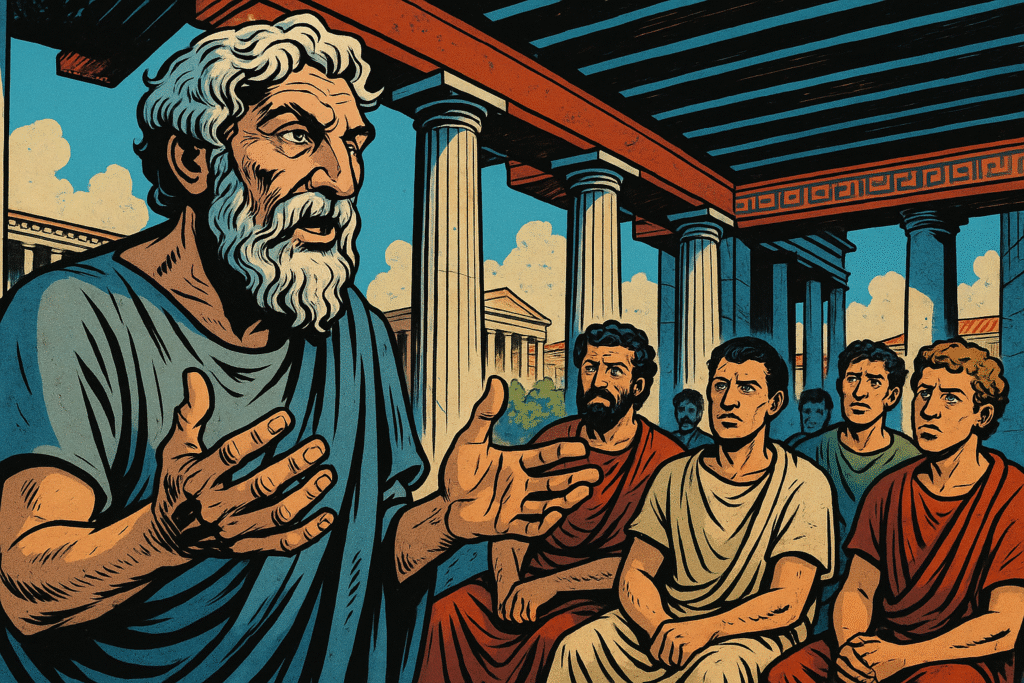
After gaining his freedom, Epictetus moved to Nicopolis in western Greece and opened a philosophy school. His teaching style was conversational, direct, and practical. Rather than focusing on abstract theories, he emphasized living ethically and using reason to guide one’s choices.
Importantly, Epictetus never wrote his lessons down. Instead, Arrian, one of his devoted students, compiled his teachings into The Discourses and The Enchiridion. These works remain central texts in the Stoic tradition and are still widely read for their clarity and moral insight.
Key Teachings of Epictetus
Epictetus focused on applying Stoicism to everyday life. His approach made philosophy accessible and useful to ordinary people. Three of his most influential teachings remain relevant and practical in today’s world.
1. Focus on What You Can Control
Epictetus begins The Enchiridion with a sharp distinction:
“Some things are up to us and some are not.”
He taught that we should direct our energy only toward what lies within our control—our thoughts, choices, and values. External events, such as health, reputation, or other people’s behavior, fall outside our control.
This mindset provides a powerful tool for handling modern stressors. For example, if your flight gets delayed or someone criticizes you online, Epictetus would urge you to shift your attention inward. You cannot control the delay or the comment, but you can control your response.
Furthermore, this principle aligns closely with cognitive-behavioral therapy (CBT), which encourages individuals to change how they think in order to change how they feel.
2. Events Themselves Are Not Disturbing
In addition to focusing on control, Epictetus emphasized the role of judgment. According to him, our emotional responses stem not from events themselves, but from how we interpret them.
“It is not events that disturb people, but their judgments about them.”
This teaching invites us to challenge our assumptions. For instance, if a colleague interrupts you in a meeting, you might initially feel disrespected. However, upon reflection, you may realize that your anger arises from your interpretation, not the act itself.
Moreover, this insight helps break the automatic link between external events and emotional reactions. By pausing and evaluating your thoughts, you create space for a more rational and constructive response.
3. Live in Accordance with Nature and Reason
Beyond self-control and emotional awareness, Epictetus believed in aligning life with reason and virtue. He encouraged people to clarify their values and act in harmony with them.
“First say to yourself what you would be; and then do what you have to do.”
This advice encourages consistent, value-driven behavior. Epictetus argued that our rational nature sets us apart. By cultivating wisdom, courage, self-discipline, and justice, we fulfill our human potential.
Today, when society often emphasizes image and achievement, this Stoic idea offers a refreshing counterbalance. Living according to reason means staying true to one’s character, regardless of outcome.
Why Epictetus Still Matters Today
Clearly, Epictetus’s lessons hold enduring relevance. His emphasis on personal responsibility, rational thought, and moral clarity fits well in today’s uncertain and fast-paced world.
Many modern thinkers have drawn from his insights. For example, Albert Ellis built the foundations of rational emotive behavior therapy based on Stoic ideas. Additionally, James Stockdale, a U.S. Navy pilot imprisoned during the Vietnam War, credited Epictetus’s teachings with helping him survive captivity.
In an age where emotions often drive decision-making, Epictetus reminds us of the value of self-mastery. His teachings offer a stable foundation in a world full of distraction and distress.
Stoicism in Modern Life: Practical Applications
Adopting a Stoic mindset doesn’t require dramatic life changes. Rather, it begins with small, intentional habits that gradually reshape your perspective.
- Morning reflection: Ask, What is within my control today? Set your focus there.
- Evening review: Reflect on your actions: Did I live according to my values?
- Pause before reacting: When provoked, remember that judgment creates distress. Choose how to respond.
- Seek virtue over outcome: Let your choices reflect who you want to be, not just what you want to gain.
By consistently practicing these habits, you build what the Stoics called ataraxia—a calm and undisturbed state of mind.
Conclusion
Ultimately, Epictetus teaches us that freedom doesn’t depend on circumstances—it begins within. Although he experienced slavery, hardship, and physical disability, he discovered lasting strength in the life of the mind. His philosophy empowers individuals to face adversity with courage, to remain composed under pressure, and to live with purpose.
“Do not seek for things to happen as you wish, but wish them to happen as they do, and you will go on well.”
In a world full of change, this timeless wisdom still offers a steady guide.